










British retailers are rebuilding their offshore customer service operations around AI agents and specialist teams in Manila. The aim is no longer cheaper calls. It is fewer refunds, and a peak season that does not need a hiring spree.
Ask a UK retail operations director where the margin goes after checkout and the answer is rarely the contact centre. It is the returns bay. Retail Economics and the returns platform ZigZag put the value of non-food goods sent back to UK online retailers at £25.1bn in 2025, with roughly one order in five returned, and ZigZag’s latest annual research has clothing return rates averaging 23.6 per cent of ecommerce orders. Each of those parcels begins as a customer contact and ends, by default, as a cash refund.

Seasonal recruitment used to be the answer to the contact volume, if not to the refunds. It is getting harder to justify. The National Living Wage rises to £13.21 an hour in April 2027, an increase of 3.9 per cent, and the Black Friday, Boxing Day and January returns peaks arrive faster than temporary staff can be vetted and trained. Heading into 2027, a growing cohort of British retailers is trying something different: pairing agentic AI with brand-trained specialists in the Philippines, and writing outsourcing contracts around automated post-purchase triage, live inventory swaps and human escalation instead of a pool of people answering calls.
What Can an AI Agent Do That a “Where Is My Order?” Chatbot Could Not?
First-generation retail chatbots could tell a shopper where a parcel was. The agents going live for 2027 can act on it: they connect to the order management system, live warehouse and store stock and the returns portal, and complete a multi-step resolution, such as a size swap, before any refund is issued.
The older bots deflected routine tracking queries across Royal Mail, Evri, DPD and DHL, then stopped short the moment a shopper decided to send something back. That is the point at which gross margin is won or lost, and it is where the new division of labour begins.
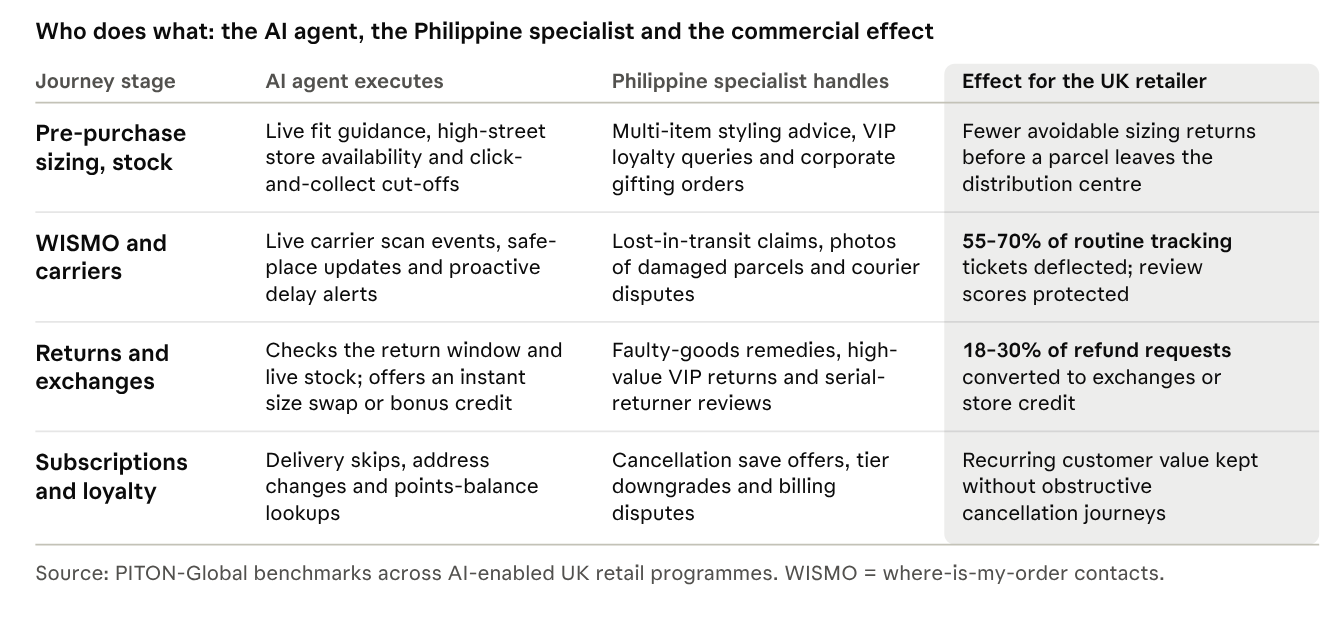
Take a shopper returning a coat that is a size too small. The agent confirms the order is inside the return window, finds the next size in a Leeds store and a Midlands warehouse, offers a swap with free delivery alongside the refund, and issues the label. If the shopper adds that the zip is broken, that is a faulty-goods claim, and the conversation passes to a specialist in Cebu with the order history attached.
“The offshore model a British retail leader pictures is often a decade out of date,” says John Maczynski, chief executive at PITON-Global, the vendor-neutral adviser on retail outsourcing to the Philippines for UK brands, and formerly global executive vice-president of the biggest contact centre provider in the world. “The labour cost advantage in the Philippines is still substantial, but the real commercial shift in 2027 is using AI to resolve predictable tracking and exchange workflows in seconds while specialists in Manila or Cebu own the complex sizing, damaged-parcel, and loyalty-saving judgement calls.”
Benchmarks the firm has compiled across AI-enabled UK retail programmes show how the work divides (Table 1). They are an adviser’s figures, not audited industry data, but they give the split a shape.
How Much Margin Is Really at Stake in a Return?
On PITON-Global’s benchmarks, an agent that checks the return window, finds replacement stock and offers an instant size swap or bonus store credit converts 18 to 30 per cent of refund requests into retained sales. For a retailer turning over £100m online, that is roughly £3.5m to £5.9m a year.
The arithmetic fits on a napkin (Figure 1). At the sector-wide return rate of 19.5 per cent, a retailer with £100m of online non-food sales sees £19.5m come back. Every one of those requests passes through a moment when the shopper is still in the conversation and the replacement either is or is not in stock. An agent wired into live inventory can make the offer in that moment. A contact centre working through a queue usually cannot.
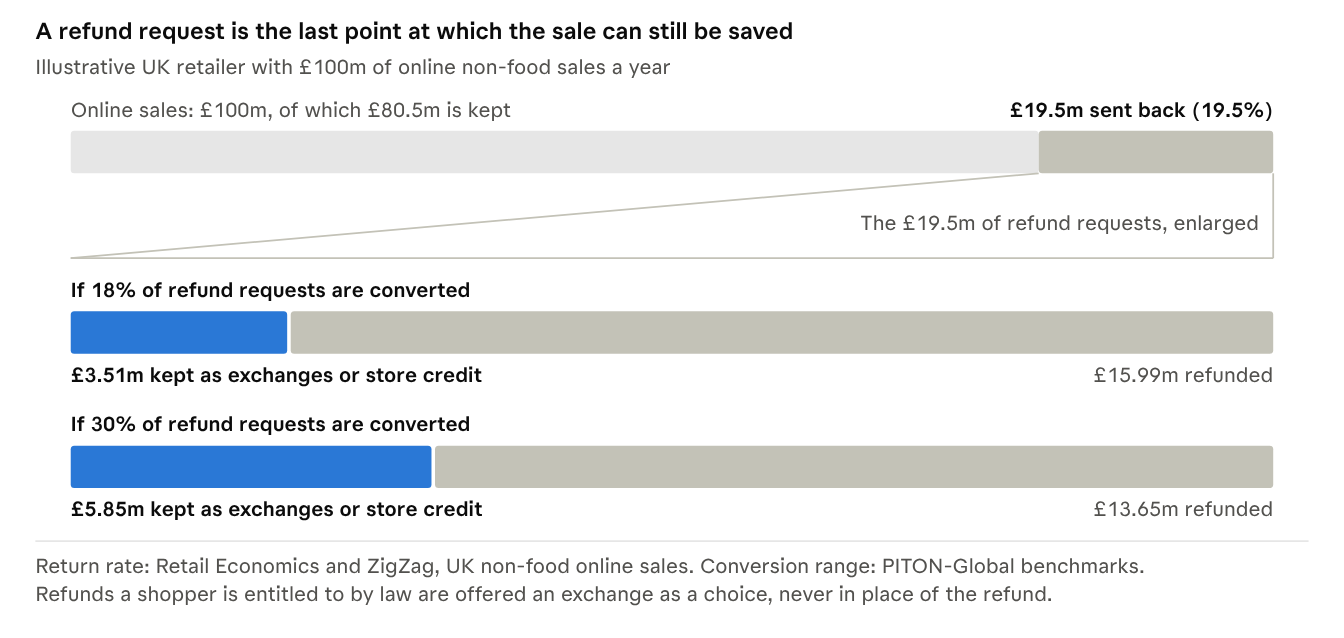
There are limits, and they are legal as well as commercial. A shopper who cancels an online order within 14 days is entitled to the money back, and the retailer must refund within 14 days of receiving the item; faulty goods carry their own statutory remedies. An exchange or a credit can be offered, never imposed, which is why the benchmark programmes send faulty-goods claims and high-value returns to a person. ZigZag’s research also finds that sizing and fit remain the primary reasons for fashion returns, so the cheapest return is still the one that better fit guidance prevents before the parcel leaves the warehouse.
How Do Retailers Get Through Black Friday, Boxing Day and the January Returns Wave?
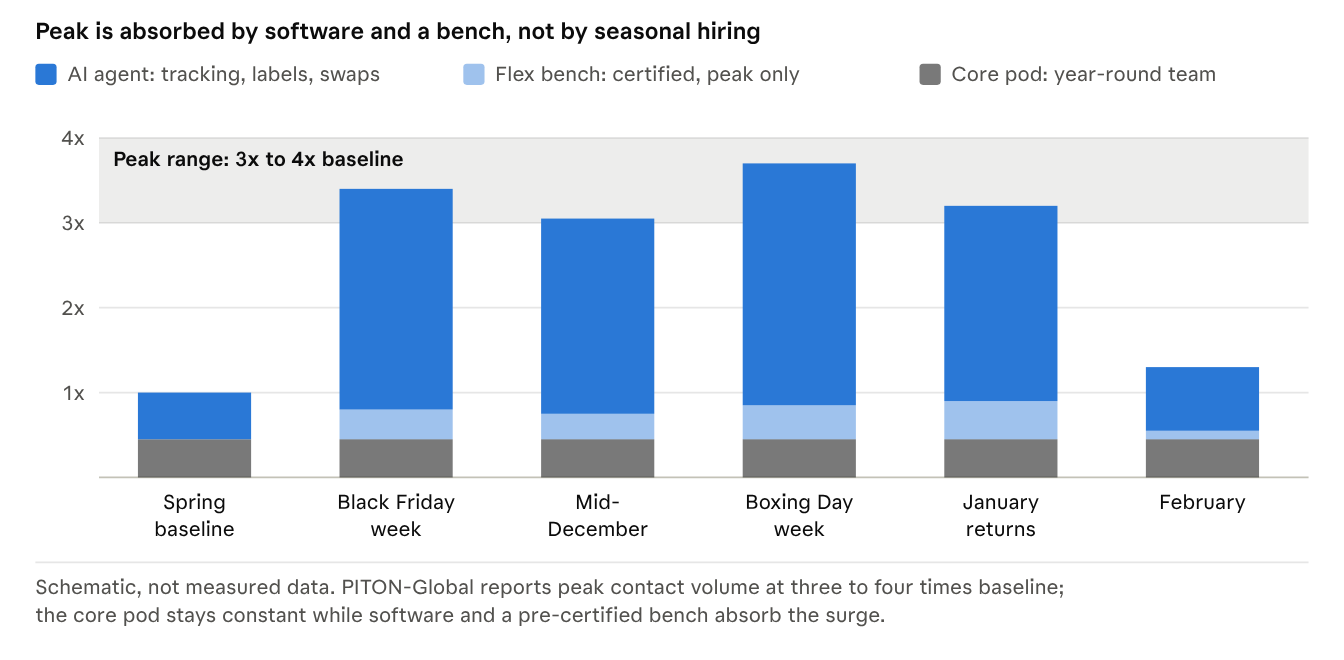
By splitting capacity in two. A year-round pod of Philippine specialists, trained on the brand, takes the judgement calls. AI concurrency absorbs the surge in tracking and label requests at minimal marginal cost, and a pre-certified flex bench steps in for the exceptions. Nobody is hired in November and released in January.
UK retail demand swings hard. PITON-Global says Black Friday, Boxing Day and the January returns surge routinely push contact volume to three or four times its baseline, and much of that surge is a delivery problem. Citizens Advice reported on 18 November that 30 per cent of people who received a parcel in the past month had a problem with it, about 14.6 million people, and that 35 per cent of those met further trouble when they tried to get it resolved. Recruiting, vetting and training temporary UK staff for that wave is expensive and slow, and most of them have gone by February.
“The return on retail outsourcing isn’t driven simply by hourly rates,” notes Ralf Ellspermann, chief strategy officer at PITON-Global. “It comes from fewer errors, faster decision cycles, and the ability to absorb peak demand without breaking service quality or carrying idle fixed headcount for nine months of the year.”
In the mature programmes the firm describes, the two tiers run across Metro Manila and regional hubs such as Cebu and Iloilo (Figure 2). The core pod knows the brand’s tone, its order systems and UK consumer-rights rules. The bench is certified on the same material in the autumn and called up for the complex carrier, click-and-collect and payment exceptions that the software hands over.
What Does It Cost, and How Are the Contracts Changing?
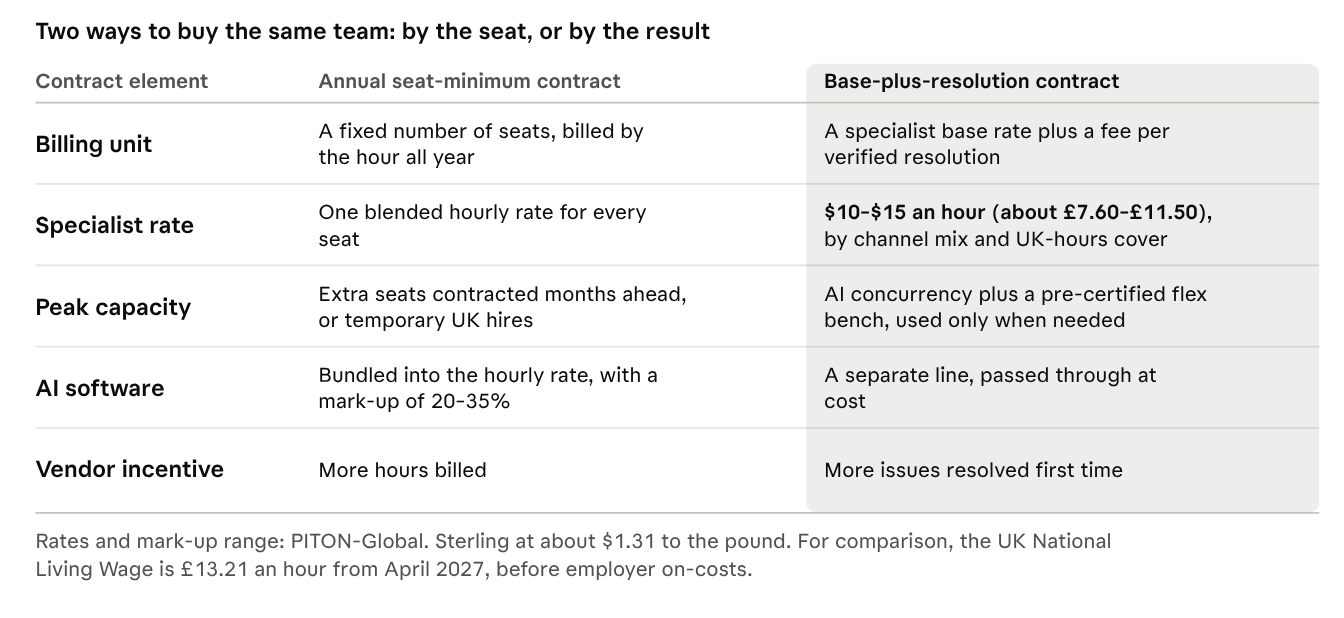
Dedicated Philippine retail specialists are typically priced at $10 to $15 an hour, roughly £7.60 to £11.50, depending on channel mix and UK trading-hour cover. The bigger change is structural: procurement teams are replacing annual seat minimums with a base rate plus payment per resolution, and itemising AI software at cost.
Set against domestic costs, the gap is plain. From April 2027 the statutory wage floor for a UK worker aged 21 or over, £13.21 an hour, will sit above the top of that fully billed Philippine band before employer National Insurance, pension contributions, premises or management are counted.
But the rate is no longer where buyers are concentrating. As AI deflection rises, a contract that pays by the seat rewards the provider for hours and penalises it for every contact the software resolves. Hybrid contracts are meant to fix that (Table 2), and to stop vendors folding AI licences into the hourly rate at what PITON-Global says can be a 20 to 35 per cent “AI wrapper” mark-up.
The detail matters. A resolution has to be defined, usually as a contact closed with no repeat inside a set number of days, and audited from the retailer’s own systems, or the fee rewards closing tickets instead of fixing problems. Buyers are also asking to own the prompts and escalation rules written on their data, so that changing provider does not mean starting again.
What Guardrails Are UK Boards and General Counsel Asking For?
Tighter ones. Because the Philippines has no UK data-adequacy decision, shopper data viewed from Manila must move under the UK’s International Data Transfer Agreement, or its Addendum to the EU clauses, with a written transfer risk assessment. Buyers insist on four operating standards: British tone, hard refund ceilings, locked desktops and a second site.
For a retail board, scaling AI offshore means tightening controls, not loosening them. The transfer paperwork sits within UK GDPR, the Data (Use and Access) Act and the PECR marketing rules, and it is the part general counsel ask about first. The part that decides whether shoppers notice is operational (Table 3).
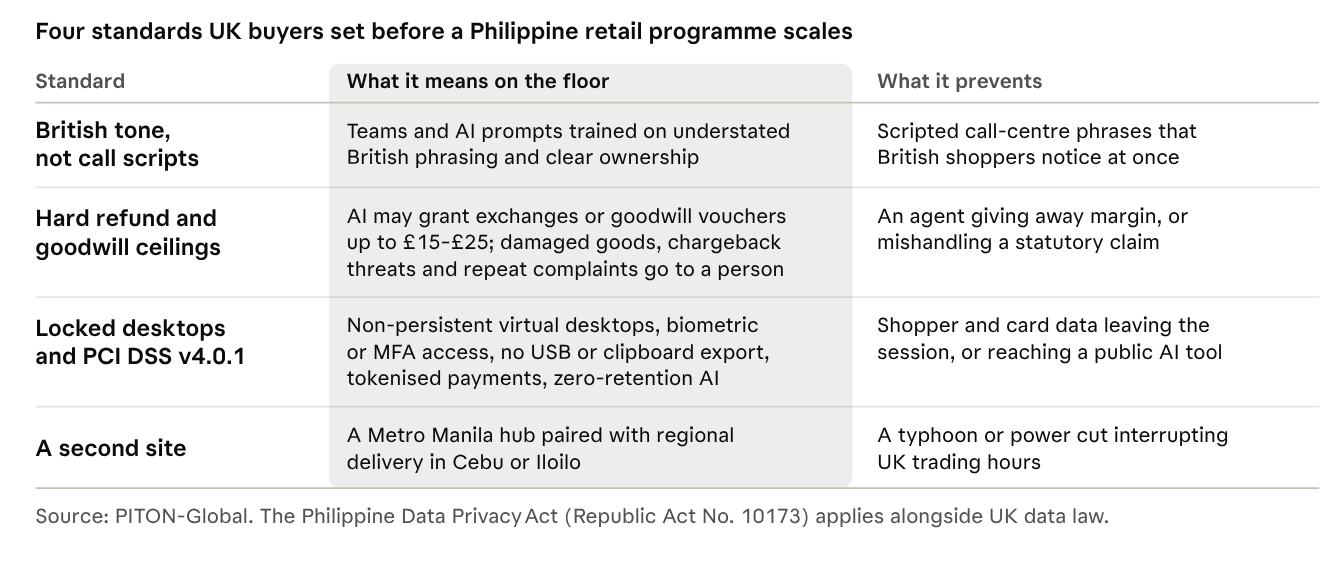
The second standard is the one finance directors read twice. In the programmes PITON-Global describes, an agent may grant an instant exchange or a goodwill voucher of up to £15 to £25 on its own authority. Anything involving damaged goods, a chargeback threat or a repeat complaint is passed, with its history, to a senior specialist.
None of this makes the Philippine option a formality. The conversion and deflection figures are an adviser’s benchmarks, and they will vary by category and by how clean a retailer’s inventory data is: an agent can only offer a size that the stock file says exists. The line between an exchange offer and an obstacle to a refund is one regulators are watching.
But the direction is hard to miss. The retailers moving first have stopped asking what an offshore seat costs and started asking what a return costs. For 2027 they are buying the operation that answers the second question.

Terry Clark is the Publisher and Content Director of 365 Retail, with more than a decade of experience covering retail design, technology innovations, store openings and the wider retail industry. He also works closely with leading retailers, suppliers, agencies, events and industry awards across the UK.