








Walk through almost any town centre and the boarded windows tell a familiar story. Shop vacancy now nears 19% in the hardest hit cities, and chain retailers shut thousands of units every year. Those empty spaces are not simply being lost, though. Across the country they are reopening as flats, studios and family housing above refreshed ground floors. In Northampton, where former department stores are coming down to make space for new living, experienced Estate Agents in Northampton are already letting and managing the homes these schemes produce. Here is how the retail to residential shift works, why it keeps gaining pace, and what it means for tenants, property owners and the shops still trading.
Key Takeaways

- Vacant units now top 19% of city centre space in the worst affected towns.
- Owners can switch most Class E premises into dwellings under Class MA, skipping a full planning bid.
- Northampton is razing old department stores to add several hundred homes near its high street.
- West Northamptonshire rents climbed 4.8% in the year to early 2026, reaching just over £1,000 a month.
- Turning shops into flats trims dead floorspace, boosts daytime activity and feeds local rental demand.
Britain’s High Streets Hold Too Much Shop Space
High streets across Britain carry more retail floorspace than current demand can fill. A 2025 study found city centre vacancy ranging from 7.4% in London to 19% in Newport, with Bradford and Blackpool close behind. You can read the full research from the Centre for Cities for the city by city picture.
The cause runs deeper than online shopping. Weaker local spending power and a surplus of units in struggling towns both play a part. To rebalance things, the think tank has urged around £5 billion of public investment to remodel the worst affected centres.
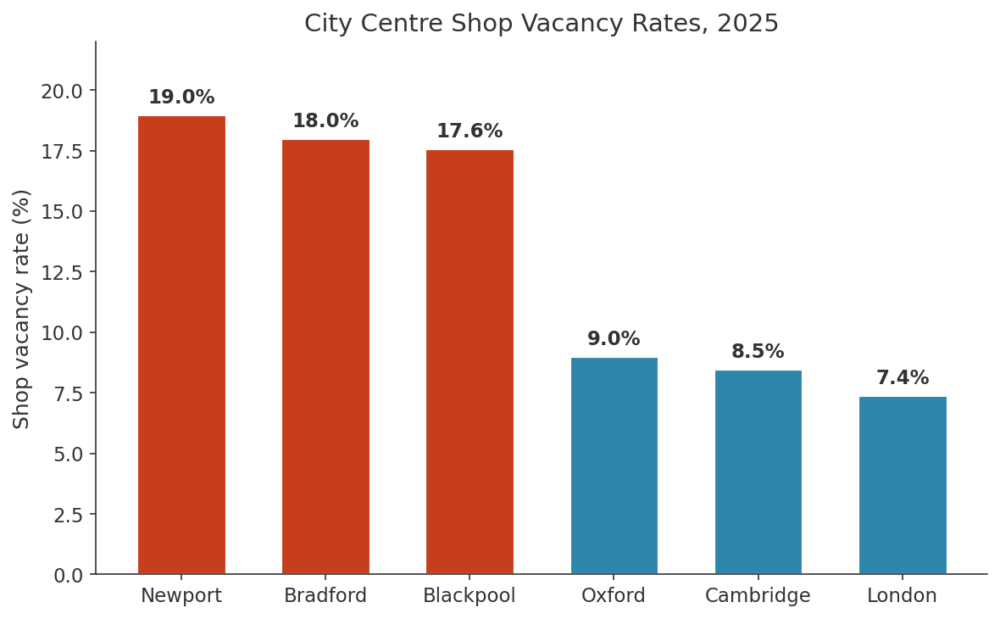
City centre shop vacancy rates, 2025 (Centre for Cities).
Physical retail keeps contracting on top of that. Across Great Britain during 2024, roughly 12,804 chain stores closed while about 9,002 opened, a net loss near 3,800 outlets. Our look at the future of the British high street digs into where this leaves towns hunting for relevance.
This clip runs through the brands leaving the high street and the cost pressures driving them out.
| Key stat: Researchers estimate that reviving struggling high streets could require as much as £5 billion in targeted public investment. |
How Class MA Turns Empty Shops Into Homes
Class MA is a permitted development right in England that allows commercial buildings in Use Class E to change to residential use under Class C3 without full planning permission. Introduced in August 2021, it covers shops, offices, cafes, gyms and similar premises via a prior approval process.
Amendments that took effect on 5 March 2024 widened the right considerably. The government removed the 1,500 square metre floorspace cap and dropped the rule that a unit had to sit empty for three months before conversion could start.
| Class MA rule | Before March 2024 | From March 2024 |
|---|---|---|
| Floorspace limit | Capped at 1,500 sq m | No floorspace limit |
| Vacancy requirement | Empty for 3 months first | No vacancy needed |
| Planning route | Prior approval | Prior approval |
| Prior Class E use | 2 years | 2 years |
Owners still have to satisfy prior approval tests covering natural light, noise, flood risk, contamination and fire safety, and finished homes must meet national space standards. Conservation areas and Article 4 directions can also limit where the right reaches.
| Pro tip: Before buying a vacant unit to convert, check for an Article 4 direction. It can switch off Class MA in that area and force a standard planning application instead. |
Inside Northampton’s Town Centre Transformation
Northampton offers a clear view of this transformation on the ground. West Northamptonshire Council has secured over £33 million of government funding through its Town Investment Plan to rework the centre, including £24.9 million from the Towns Fund.
The most visible work sits at 35 to 45 Abington Street. Demolition crews spent 2025 clearing the former Marks & Spencer, British Home Stores and a jobcentre to make way for modern homes above flexible retail and leisure space. Council leaders expect the scheme to deliver hundreds of homes on a long vacant stretch of the high street.
| Site | Former use | New direction | Status |
|---|---|---|---|
| Abington Street block | Department stores, jobcentre | Homes above retail and leisure | Demolition underway |
| Greyfriars | Former bus station site | New housing and public realm | In development |
| Market Walk | Vacant shopping centre | Food hall and leisure venue | Being repurposed |
| Town centre masterplan | Underused sites | Mixed homes and amenities | Long term plan |
Several projects reinforce the pattern. The Greyfriars site is being redeveloped for new homes and improved public space, while the empty Market Walk centre is turning into a food hall and entertainment venue. A draft masterplan now sets a vision spanning fifteen years built around town centre living, with homes for families, older people and younger workers on underused plots. It echoes wider predictions about high street transformation by 2050.
What the Shift Means for Renters, Landlords and Retailers
New town centre homes arrive in a rental market that is already tight. The latest official rental figures put the average monthly private rent in West Northamptonshire at £1,066 in January 2026, a 4.8% annual rise, while the average house price reached £294,000.
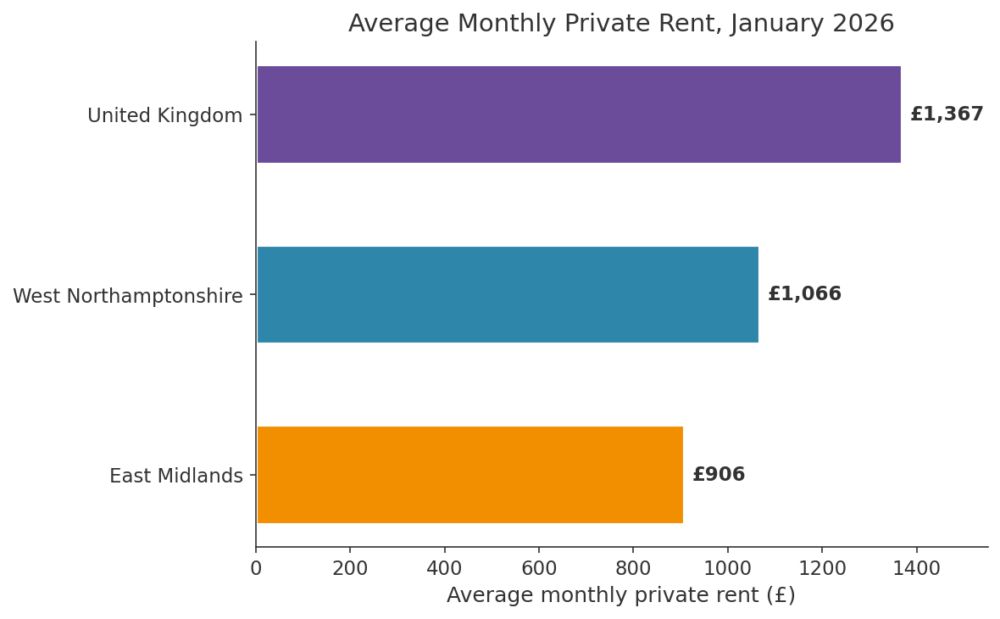
Average private rents, January 2026 (Office for National Statistics).
For landlords, conversions open a fresh pool of well placed stock close to transport, jobs and shops. For renters, central flats trim commuting and put daily needs within walking distance. For the shops that remain, more residents nearby brings steadier footfall through the week, a theme explored in our guide on how retailers can win back footfall.
Conversions cut empty floorspace, lift footfall and give local landlords a steady pool of tenants right in the heart of town.
Management still matters once the keys turn. One long standing landlord shared on a recent Google review that the team had acted as their letting agents for over ten years, staying thoroughly professional and reliable throughout. For owners of newly converted flats, that steady oversight is what keeps a home let and maintained rather than empty. The same logic helps the independents that give a centre its character, as seen among Britain’s top hotspots for independent shops.
Frequently Asked Questions
Can any shop be converted into a home?
Most premises in the Class E category, such as shops, offices and cafes, can become homes under Class MA. The building normally needs a lawful Class E use for two years and must clear prior approval checks first.
Does converting a shop to flats need planning permission?
Often no. Class MA allows the change from commercial to residential through a prior approval application rather than a full planning application, provided the site meets conditions on light, space, noise, flooding and fire safety.
Are town centre flats a good rental investment?
Central flats sit near transport links, jobs and amenities, which supports steady tenant demand. In West Northamptonshire, average private rents rose 4.8% over the twelve months to January 2026, reflecting firm appetite across the area.
Why are so many UK shops closing?
Online shopping, higher operating costs and softer local spending power have cut demand for physical retail. Many town centres simply hold more shop space than shoppers now need, leaving units empty for long stretches.
What happens to the ground floor after a conversion?
Many schemes keep active ground floors for shops, cafes or leisure while placing homes above. This mixed use approach maintains a working frontage and brings new residents into the centre at the same time.
The Town Centre Comeback Takes Shape
The empty shop is slowly becoming something more useful. As Class MA makes conversions simpler and councils back schemes like Northampton’s, redundant retail space is turning into the housing that town centres badly need. The change will not suit every street, and getting the balance right takes care. Handled well, it brings residents back to the heart of towns, supports the traders who stay, and gives landlords a fresh supply of homes in places people actually want to live.

Terry Clark is the Publisher and Content Director of 365 Retail, with more than a decade of experience covering retail design, technology innovations, store openings and the wider retail industry. He also works closely with leading retailers, suppliers, agencies, events and industry awards across the UK.