

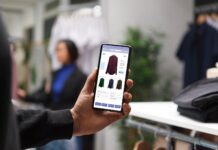







On a Saturday afternoon, a shopper sets out to buy a floor lamp. A few years ago she would have gone to the high street and picked one out in person. This time she asks an AI assistant on her phone, looks through the five shops it recommends in a few minutes, and orders from one with home delivery. A shop down the road had the same lamp in stock. She never saw it.
AI is hitting UK physical retail hard, but stores can put it to use too. Break the customer’s path to purchase into three stages and the damage and the benefits look different at each one, so stores can plan their response stage by stage.

Before customers walk in: online shopping and AI assistants pull them away
This is where the impact is biggest. ONS figures show online sales made up 29.4% of UK retail sales in June 2026, the highest share since April 2021. In July it was about 28.3% (Great Britain basis). BRC-Sensormatic data show total UK retail footfall fell 2.9% year on year in September (30 August–3 October), after a 1.7% fall in August.
AI makes shopping online easier still. UK data from the Adyen 2026 Retail Report (surveyed by Censuswide in November–December 2025) show the share of UK consumers using AI assistants to shop rose from 12% to 28%, and 44% would let AI handle the whole process, including placing the order. In an Ipsos survey from July 2026, 27% of shoppers were already using AI to research products before buying, and another 43% were open to trying it.
People usually visit a store to see what a product looks like in real life and what it costs. An AI assistant can answer both questions online, which leaves far less reason to make the trip.
Using AI inside the store
Around 70% of retail sales still happen in stores. AI has uses there, though mostly behind the scenes rather than in front of customers. In March 2026, M&S gave 11,000 staff, including every store manager, AI tools such as Microsoft 365 Copilot. Yet Deloitte UK’s survey on generative AI at work, published on 16 November 2026, found that only 48% of UK retail workers who had used generative AI said it saved them time.
On shelves and stock, electronic shelf labels let stores change prices in bulk, and Morrisons now lets shoppers search for a product in its app and make the shelf label flash so they can find it. On loss prevention, the BRC 2026 Crime Report recorded around 5.45 million incidents of shoplifting, and retailers have spent roughly £5 billion over the past five years on CCTV, security staff, anti-theft equipment and body-worn cameras. AI video analytics is one of the options retailers are now trialling.
Getting your products found online
When an AI assistant recommends products, it works from what it can find online: product names, attributes, images, prices and stock levels. If an item is on the shelf but not listed online, it won’t appear in the AI tools customers are using. M&S partnered with Lily AI in July 2026 to make its products more visible on Google and in AI shopping channels.
For a small shop, doing the same costs little. A boutique can take good flat-lay or hanging shots, use an AI fashion model generator to create on-model images, and post them on its website, Google Business Profile or social media. Homeware, gift and general stores can photograph products on a phone, upload the photos to Snappyit’s AI product image generator as a reference, and use a prompt to swap in a clean background or a lifestyle scene for online product pages and click & collect pages. Keep stock and pickup details current and accurate as well. The more reliable that information is, the more likely AI search is to surface it.

Once a product is found, customers still need a reason to come in. List sizes, materials and prices on the page, and label items “In stock in store” or “Ready for pickup today”. Click & collect and in-store stock checking are the two features that turn online traffic into store visits.
What to do first
Start online, then move to the store:
- Fill in photos, dimensions and materials for your 20 to 30 best-selling products.
- List those products on your website and Google Business Profile, with prices and stock levels.
- Set up in-store pickup.
- Record the number of click & collect orders each month.
Once pickup orders are coming in, extend the work to the rest of the range. You’ll also have real numbers to judge whether in-store AI tools are worth the spend.

Terry Clark is the Publisher and Content Director of 365 Retail, with more than a decade of experience covering retail design, technology innovations, store openings and the wider retail industry. He also works closely with leading retailers, suppliers, agencies, events and industry awards across the UK.