











For retailers, selling a conventional bicycle and selling an electric bike present different merchandising challenges. When buying a traditional bicycle, customers typically focus on frame size, intended use and price. With an electric bike, however, there are several additional factors to consider, including battery capacity, riding range, tyre size, folding design, braking systems and the practical differences between individual models.
This makes electric bikes a product category that requires more thoughtful organisation. Even when two models belong to the same broad category, they may be designed for entirely different purposes. For retailers, the real challenge is not simply adding more specifications to a product page, but organising information in a way that helps customers understand the differences between products more easily.

Electric Bikes Are Not a Single Product Category: Classification Should Start with Customer Needs
When customers search for an electric bike, they often already have a particular use in mind. Some want a model for everyday short-distance journeys, others need a bike that can be folded and stored in a limited space, while some prioritise wider tyres and suspension for riding on different surfaces.
If an online retailer places every model in one large product listing, customers must open individual product pages to work out which bike meets their requirements. This increases the effort involved in comparing products and makes it harder to identify meaningful differences.
A more effective approach is to organise products around their primary intended uses while retaining additional filters that highlight specific features. For example:
- City electric bikes: Focus on frame design, riding comfort and everyday convenience.
- Folding electric bikes: Highlight folding mechanisms, storage dimensions and overall weight.
- Fat tyre electric bikes: Emphasise tyre specifications, tread design and suitability for different surfaces.
- Off-road electric bikes: Showcase suspension systems, braking components and intended riding conditions.
This approach allows customers to find a relevant product category first and then compare individual specifications. For retailers offering several models, a clearly organised electric bike range can be more useful than simply increasing the number of products listed.
Product Pages Should Answer Real Customer Questions, Not Just List Specifications
A detailed specification sheet does not necessarily mean customers can easily understand a bicycle.
Consider someone comparing two electric bikes at a similar price. One has a larger battery, while the other features a removable battery and a folding frame. If the product pages only display battery capacity and the folding feature, without explaining the actual dimensions, overall weight or charging arrangements, customers may still struggle to decide which model better suits their circumstances.
Retailers should organise product information around the decisions customers need to make.
First, dimensions and storage information. Alongside frame measurements, retailers should provide overall weight, folded dimensions and details about how easily a bike can be moved. For people living in flats or storing their bicycles in a limited space, these details may be more important than certain performance specifications.
Second, battery and range information. Whether the battery is removable, how long charging takes and the conditions behind the stated riding range should all be explained clearly. Range should not simply be presented as a maximum figure; customers should understand that actual performance can vary.
Third, riding components. Tyre sizes, gearing systems, brake types and suspension configurations should be presented in relation to the bike’s intended use. Retailers do not need to explain every technical detail at length, but they should make clear what each component contributes.
Finally, after-sales and delivery information. Warranty coverage, delivery arrangements, assembly requirements and spare parts availability can all influence purchasing decisions, particularly for higher-value products.
The purpose of a product page is not to display as many technical terms as possible. It is to reduce uncertainty and help customers make informed decisions.
Folding Electric Bikes: Product Listings Should Explain More Than Just the Folding Feature
Folding electric bikes provide a particularly useful example of why product presentation matters.
Many product pages make the folding frame their main selling point. However, for customers, the ability to fold a bicycle is only part of the equation. How easy it is to carry once folded, whether it fits into the intended storage space and how convenient the folding process is can all affect the ownership experience.
For example, someone living in a flat may want to store their bike in a limited space at home. A photograph showing the folded bicycle is not enough to establish whether it will actually fit. Customers also need to know its folded dimensions, overall weight and whether the battery can be removed separately.
Retailers should ideally provide:
- Images showing the bicycle in both unfolded and folded positions.
- Folded length, width and height.
- Overall weight and practical handling information.
- Clear instructions showing how the folding mechanism works.
- Details of whether the battery is removable.
- An explanation of how the folding design works alongside the tyre configuration.
One detail that is often overlooked is that a folding design does not automatically make a bicycle lightweight. A folding electric bike equipped with wide tyres and a larger battery may be easier to store, but it may not be particularly convenient to carry up several flights of stairs.
When comparing different folding electric bikes, customers should therefore consider both storage convenience and overall weight rather than making a decision based solely on whether a model can be folded.
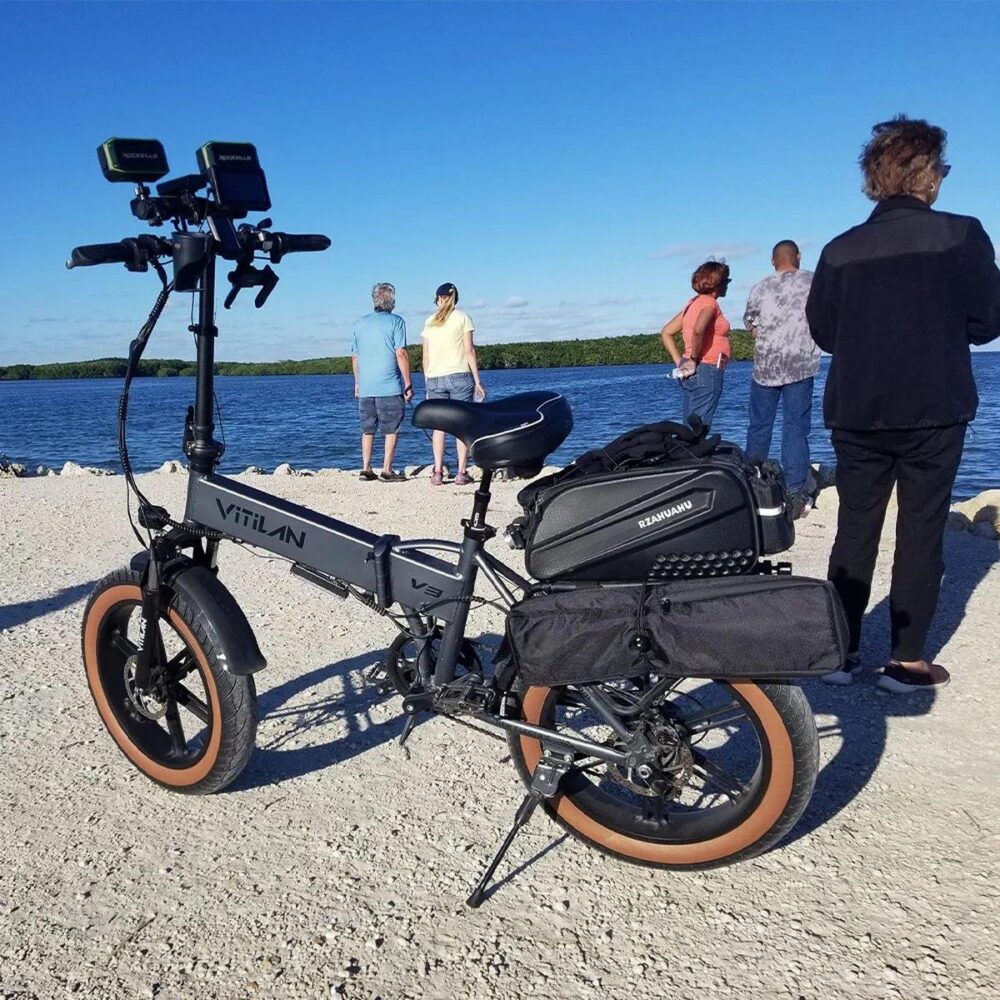
VITILAN V3 2.0: An Example of a Product That Spans Multiple Categories
Some products do not fit neatly into a single category. For retailers, these cross-category products deserve particular attention because assigning them just one label may not fully reflect their design.
The VITILAN V3 2.0 is a useful example. It combines a folding frame with 20 × 4-inch wide tyres, giving it characteristics associated with both folding electric bikes and fat tyre electric bikes.
From a merchandising perspective, this type of model should not rely on a single product label. Retailers could use the folding design as its primary category while allowing customers to filter by additional attributes such as tyre size, battery type and gearing system.
The V3 2.0 includes several key features:
- Folding frame: Designed to make storage more convenient when the bike is not in use.
- 20 × 4-inch wide tyres: A characteristic fat tyre specification.
- 48V 13Ah removable battery: Allows the battery to be taken out separately for charging.
- Claimed range of 48–73km: Provides a reference for customers, although actual performance depends on riding conditions.
- Shimano 7-speed gearing: Offers a choice of gear ratios for different riding conditions.
- Hydraulic disc brakes: Form part of the bike’s braking configuration.
This example illustrates the difference between product categories and product attributes. A bicycle can belong to the folding category while also having wide tyres, a removable battery and other distinguishing features. If an online retailer only allows customers to search by one category, it may reduce the chances of relevant products being discovered.
A more effective product information structure combines primary categories, secondary tags and filterable attributes. This avoids creating numerous overlapping product pages while allowing customers to discover the same model through different search paths.
Clearer Product Information Is Part of the Retail Experience
Competition in the electric bike retail market is not simply about product numbers or pricing. For products that require careful comparison, the ease with which customers can find and understand relevant information can influence whether they continue exploring a purchase.
Retailers can improve product presentation in three ways: organise categories around genuine customer needs, prioritise key information such as dimensions, battery details, range and component specifications, and use cross-category tags and filters for products with multiple characteristics.
The VITILAN product range provides an example of how different electric bike designs can be organised and presented. For retailers, the goal should not simply be to add more product labels, but to ensure that each category helps answer a genuine customer question.
When product information is clear and accessible, customers spend less time trying to work out whether a particular bicycle suits their circumstances. For a considered purchase such as an electric bike, that clarity is an important part of the overall retail experience.

Terry Clark is the Publisher and Content Director of 365 Retail, with more than a decade of experience covering retail design, technology innovations, store openings and the wider retail industry. He also works closely with leading retailers, suppliers, agencies, events and industry awards across the UK.