









A high street is more than a place to buy milk and book a haircut. It tells you something. When the shopfronts are full, the cafes are busy and the pavements feel cared for, buyers read that as a good place to live, and they pay accordingly.
The opposite also holds true. That is why the roughly one in seven shops now standing empty across the country worries homeowners as much as it troubles retailers.


Local property experts such as Oliver Jaques, who have worked the same South East London streets since 1986, watch this play out every week. The health of the parade around the corner quietly shapes what buyers will offer nearby. This guide looks at how a lively local centre lifts the value of the homes around it, and what that means whether you are buying, selling or investing.
Key Takeaways
- Busy, full high streets signal desirable areas, and buyers pay more to live close to them.
- Homes near a popular supermarket can carry a premium worth tens of thousands of pounds.
- Low vacancy, cafes and events raise footfall and lift demand for the property nearby.
- Boarded up shopfronts drag on local prices and deter would be buyers.
- Regeneration that blends shops, leisure and housing tends to raise values across a district.
Why the High Street and House Prices Move Together
High streets and house prices are linked because a vibrant local centre makes the surrounding area a more desirable place to live.
Convenience carries real weight with buyers. Being able to walk to a coffee, a chemist and a fresh loaf saves time and lifts daily quality of life, so people compete harder for homes that offer it.
Schools, parks and transport pull in the same direction, yet the parade of shops is the amenity a viewer notices first.
Access to good amenities mattered to 54% of home movers in a Strutt & Parker Housing Futures survey, up from 39% a decade earlier. That preference is not abstract; it shows up in what people actually pay.
Research by Lloyds Bank found that living within easy reach of a supermarket adds around £22,000 to a typical home, with the largest premiums attached to the most popular names. Buyers are really paying for the convenience, footfall and sense of a cared for neighbourhood that a good store signals.
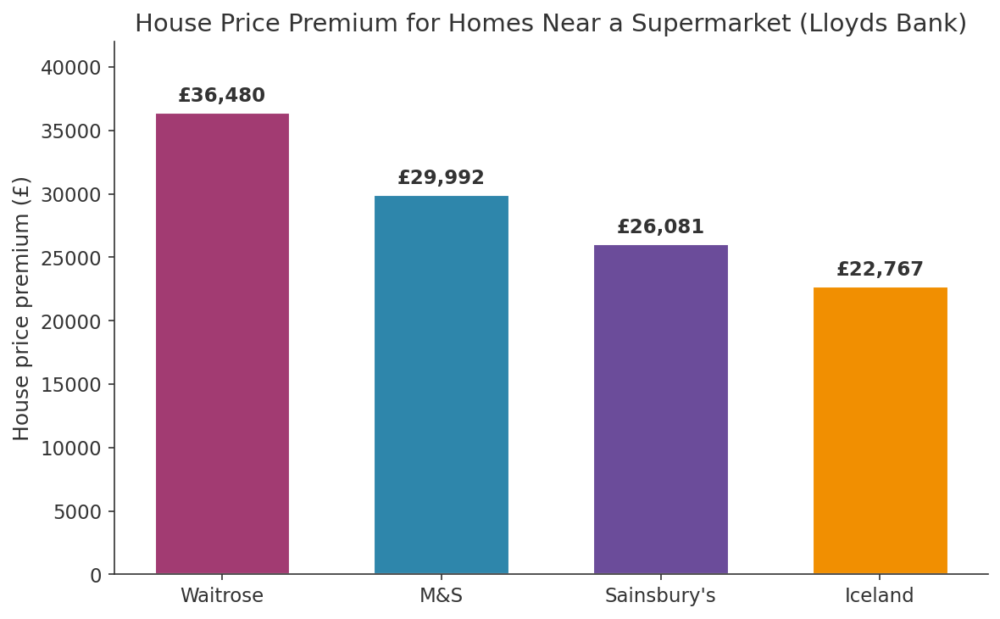
Premium over the wider town average for homes near each supermarket brand (Lloyds Bank research).
| Key figure: Homes beside a popular supermarket brand can command a premium above £36,000 in Lloyds Bank’s analysis. |
The exact figure shifts with the brand and the area, yet the direction of travel rarely changes. Well served, walkable locations command more, and estate agents price that difference into every valuation.
What a Thriving High Street Looks Like
A healthy high street keeps most units occupied, footfall steady, and the offer reaching beyond shops into food, leisure and services.
Vacant units are the clearest warning sign of trouble. Across Great Britain, about one in seven storefronts sits empty, although that headline average hides a sharp regional divide.
| Thriving high street | Struggling high street |
|---|---|
| Most units occupied, low vacancy | Boarded up and shuttered shopfronts |
| Mix of cafes, independents and services | Reliance on a few discount or betting shops |
| Steady footfall and long dwell time | Falling footfall and quick visits |
| Events, markets and evening trade | Little reason to linger after dark |
| Rising demand for nearby homes | Weaker demand and softer prices |
The gap is stark. Recent Local Data Company figures put shop vacancy at roughly 13.7% in the South East, against about 23% in the North East. Centre for Cities research adds that empty units can be more than twice as common in weaker town centres as in the strongest performers.
High street shop vacancy varies widely by region (Local Data Company via Power to Change, 2025).
The centres that hold up best have often shifted from pure retail towards cafes, restaurants and experiences people cannot buy online. In prosperous places like York and Edinburgh, roughly one pound in every four spent in the centre now goes on food and drink. Markets, events and independent traders all pull people in and keep them there.
For retailers trying to reverse decline, our guide on how to win back footfall sets out practical tactics. Centre for Cities analysis of why some high streets thrive while others struggle is worth reading alongside it, because the same forces that fill shops also firm up nearby home values.
How High Street Health Feeds Into Property Value
The link between a busy centre and stronger prices runs through a few clear channels. Walkability is one of the most powerful.
Transport for London has found that people who walk to a high street tend to spend more over time than those who arrive by car, and the charity Living Streets reports that better pedestrian conditions can raise footfall by 20% to 35%.
| High street factor | Effect on nearby homes |
|---|---|
| Good amenities within walking distance | Higher premiums and stronger buyer demand |
| Low vacancy and active shopfronts | A sense of vitality that lifts desirability |
| Cafes, leisure and events | Longer dwell time and a place people want to live |
| Regeneration and mixed use | Value uplift plus new homes and services |
| Empty, vandalised units | A drag on prices and a signal of decline |
More footfall sustains more shops, which keeps vacancy low and the street feeling alive. That sense of vitality, sometimes measured as dwell time, is precisely what people are buying into when they choose one postcode over another.
A safe, active parade also improves how a whole neighbourhood is perceived, and perception feeds directly into asking prices. First impressions on the walk from the station or the school run do quiet work on a viewer’s sense of worth.
| Warning: Empty and vandalised units work in the other direction. A run of shuttered shopfronts can signal decline, unsettle buyers and pull surrounding valuations down before a single price is agreed. |
Regeneration, Mixed Use and the Value Uplift
Regeneration raises property values when it turns dead retail space into something people genuinely want. The national picture shows an oversupply of shops alongside a shortage of housing, so many schemes now convert empty units into flats, workspace, healthcare and leisure. Government policy points the same way, giving councils new powers for councils to fill empty shops through rental auctions.
Mixed use creates a virtuous circle. Fresh residents become customers for the traders who remain, footfall climbs, and the area grows more appealing to the next wave of buyers. Public services such as surgeries and libraries add another reason to visit, while green space and a tidy public realm lift the mood of the whole centre.
The scale can be significant. Brent Cross Town in north London will deliver 6,700 new homes alongside parks, shops and leisure, and Centre for Cities estimates that reviving struggling centres nationwide could need around £5 billion. You can see similar thinking in major urban regeneration projects across the sector, and in how shopping centres of the future are being rebuilt as mixed communities rather than pure retail boxes.
Video: “A home on the high street: a new approach to creating vibrant town centres” (https://www.youtube.com/watch?v=LlXjuj6-_V0). This short film shows how converting empty shops into homes can breathe life back into a town centre.
What This Means for Buyers, Sellers and Investors
For anyone dealing in property, the local high street is a practical gauge of where an area is heading. Buyers should walk the nearest parade before they commit, reading the mix of tenants as a leading indicator of the neighbourhood’s direction. A butcher, a busy cafe and a couple of independents usually beat a row of betting shops and shutters.
| Pro tip: Visit the high street at two different times, such as a weekday morning and a Saturday afternoon. The change in footfall tells you far more than a single quiet viewing ever will. |
Sellers gain from a strong centre too, and a sharp local agent will know how to present that advantage to the right buyers. This is where genuine local knowledge earns its keep, as one recent review of a South East London agency makes clear.
We met three agents and went with them because they knew the local market incredibly well, and backed their feedback and advice with real evidence.
GetAgent verified review
Investors tend to hunt for the sweet spot: an area with low vacancy, visible regeneration and a centre that is diversifying rather than shrinking. Getting in before the cafes and the cranes arrive is where the strongest returns usually sit. A quick scan of planning applications and new lettings on the parade often reveals which way a centre is turning.
FAQs
Do high streets really affect house prices?
Yes. A busy, well kept high street lifts the appeal of the surrounding area, which supports stronger buyer demand and firmer prices. Declining centres with many empty units tend to have the opposite effect on the homes around them.
How much does living near a supermarket add to a home’s value?
Lloyds Bank research puts the average uplift at roughly £22,000, with premium brands adding considerably more. The figure reflects convenience and desirability rather than the store itself, so it varies from one location to the next.
Do empty shops lower nearby property prices?
They can. Clusters of boarded up units signal decline and may deter buyers, an outcome often called the broken window effect. Persistent vacancy is one reason certain town centres see weaker housing demand than others close by.
Are homes near shops and cafes a good investment?
Often, provided the centre is healthy. Sitting close to a lively blend of shops, cafes and services supports both rental demand and resale value. The risk lies in places where the high street is quietly hollowing out.
Does high street regeneration increase house prices?
Usually. Schemes that cut vacancy, add homes and improve the public realm tend to lift local values over time. Mixed use projects, which bring residents and footfall together, have the strongest track record of all.
What should buyers check about a local high street?
Look at how many units are occupied, whether independents and cafes are opening, and how cared for the street feels. Steady footfall, events and low vacancy are reassuring signs that an area is likely to hold its value.
Conclusion
A high street’s condition is among the clearest signals of an area’s direction. Full units, steady footfall and a growing food and leisure scene point to rising demand and stronger prices, while boarded windows point the other way. The lesson holds firm for anyone with a stake in the market: read the street before you read the listing. The shops will often tell you what a spreadsheet cannot.

Terry Clark is the Publisher and Content Director of 365 Retail, with more than a decade of experience covering retail design, technology innovations, store openings and the wider retail industry. He also works closely with leading retailers, suppliers, agencies, events and industry awards across the UK.