








From shop floors to stockrooms, the right ceiling lighting depends on how a space is used, not simply how a fitting looks.
Walk into a shop and you may notice the displays, the flooring or the layout before you notice the ceiling. Yet the light overhead influences all three. It affects how easily customers find their way, how merchandise appears and whether staff can work comfortably through a long trading day.

Round LED ceiling lights can provide a discreet layer of general illumination in retail interiors. Their neat profile makes them easy to incorporate into many fit-outs, but choosing them on appearance alone can leave a store with dark shelves, uneven coverage or uncomfortable glare.
For retailers planning a refurbishment or fitting out a new space, a few decisions made before ordering can save a surprising amount of rework.
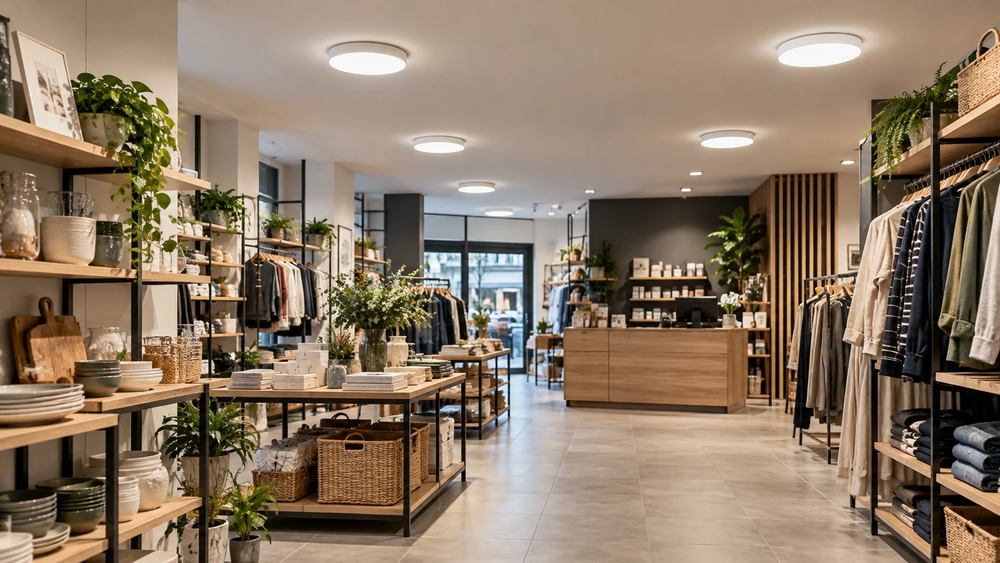
General ceiling lighting helps customers navigate a retail space while supporting a consistent visual environment. Illustrative image.
Start with the shop floor, not the fitting
A small high-street shop and a large-format retail unit may both need ceiling lighting, but the similarities end there. In one, shelving reaches almost to the ceiling. In another, merchandise is arranged on low tables, with clear sightlines across the floor. The same luminaire layout will not necessarily work for both.
Before choosing a fitting, map the areas customers actually use: the route from the entrance, main aisles, product displays, the till and any seating or consultation spaces. Then look at the tasks carried out by staff, including stock checks and cleaning after closing.
Round ceiling fittings can form a useful layer of general illumination. They are not a substitute for every type of retail lighting. Directional spotlights, for example, may still be needed to pick out individual displays or merchandise.
Why the shape and mounting method matter
A round fitting can sit quietly within a ceiling design, particularly where the interior already has strong lines from shelving, display rails and joinery. Its appearance is only one part of the decision, though.
Surface-mounted fittings are useful when there is no suitable ceiling void or when cutting into the ceiling is impractical. Recessed options can provide a lower-profile appearance, but require the correct cut-out and installation space. Those details matter in refurbishments, where the ceiling construction may already be fixed.
The diameter of the fitting matters too. A large circular luminaire may look balanced in a broad open area but visually dominate a narrow corridor. In smaller spaces, several modest fittings may be easier to position than one high-output unit.
Brightness is about the room, not just the wattage
Retailers often compare ceiling lights by their wattage because it is easy to find on a product listing. Wattage tells you how much electrical power a fitting uses, not how much useful light reaches a shelf, counter or walkway.
Lumens describe the light output of a fitting. Beam distribution, mounting height, spacing and nearby surfaces determine how that light is experienced in the room. A dark ceiling and tall shelving can change the result considerably.
For a refurbishment, compare the proposed lighting layout with the existing one rather than replacing fittings on a watt-for-watt basis. A lighting calculation or on-site assessment is particularly worthwhile for larger premises, awkward floor plans or spaces with demanding visual tasks.
Think about how products look under the light
Lighting affects more than whether a customer can read a price ticket. It also changes the appearance of fabric, timber, packaging and skin tones. Two shops can have similar light levels and still feel quite different.
Colour temperature is one reason. Warmer light, often around 3000K, can suit a relaxed boutique atmosphere; neutral white, around 4000K, is frequently chosen for clear general illumination. Neither is automatically right for every shop. The merchandise, finishes and brand presentation should guide the decision.
Colour rendering deserves attention as well, particularly where customers compare subtle colours. Ask for the fitting’s CRI and, for colour-critical displays, consider whether a higher colour-rendering specification is appropriate. A sample installation can reveal issues that are hard to judge from a catalogue alone.
Keep glare out of the customer experience
A bright ceiling is not necessarily a comfortable ceiling. Customers looking towards the back of a store, staff working at a counter and anyone standing near a reflective display may see a fitting from an uncomfortable angle.
Diffusers, optical design and luminaire placement all affect glare. So does the relationship between the light source and the surrounding surfaces. Rather than treating glare as a specification-box exercise, consider the actual viewpoints people will have when walking, browsing and working.
For businesses comparing round LED ceiling lights, the Ledex Lighting UK collection includes surface-mounted and recessed options, alongside models with selectable colour temperatures or power settings. The right choice depends on the ceiling, the activities below it and the wider lighting scheme.
The diffuser, fitting position and surrounding surfaces all influence visual comfort. Illustrative image.
Use controls where they make operational sense
The sales floor is not the only area that needs attention. Stockrooms, staff corridors, toilets and back-of-house circulation spaces may be occupied intermittently, even when the shop is open for long hours.
A suitable motion-sensor fitting can reduce unnecessary operating time in those locations. Some circular LED ceiling lights offer selectable colour temperature or wattage, which can also be useful when a standardised fitting is used across several rooms with different requirements.
Controls should match the way the space is used. A sensor that switches off too quickly can frustrate staff; a light that comes on unexpectedly may be distracting. Check the detection method, time-delay settings and installation conditions before specifying one.
Plan for cleaning, replacement and future changes
Retail interiors rarely stay exactly the same. Displays move, departments change and a new tenant may use the premises differently. A lighting scheme that works only for the opening-day layout can become inconvenient later.
Consider whether fittings will remain accessible above shelving, whether replacement units can be sourced consistently and whether a damaged fitting can be changed without major disruption. In a multi-site operation, standardising a manageable range of fittings may simplify maintenance and stockholding.
Check the manufacturer’s stated performance, warranty and installation instructions rather than assuming all LED products have the same service life. Moisture exposure and cleaning methods also matter in areas such as washrooms or certain back-of-house spaces, where the appropriate IP rating should be verified.
Make the decision on the whole installation
A cheaper fitting does not necessarily produce a cheaper lighting project. Installation labour, access equipment, controls, energy use and future maintenance can all affect the total cost.
For a simple illustration, a 20W fitting operating for 12 hours a day uses 87.6 kWh over a 365-day year. Ten such fittings use 876 kWh. The actual electricity bill depends on the tariff, operating schedule and any controls, but the example shows why hours of use matter as much as the wattage printed on the box.
The most useful starting point is a clear brief: which areas need general lighting, where display lighting is required, how the ceiling is constructed and what the store should feel like at different times of day. Once those questions are answered, choosing a round ceiling fitting becomes a practical specification decision rather than a guess.

Terry Clark is the Publisher and Content Director of 365 Retail, with more than a decade of experience covering retail design, technology innovations, store openings and the wider retail industry. He also works closely with leading retailers, suppliers, agencies, events and industry awards across the UK.