











A landlord eviction notice used to mean the same thing across the UK. Not anymore. Since 1 May 2026, landlords in England can only end a tenancy through Section 8 of the Housing Act 1988, after the Renters’ Rights Act 2025 abolished the old “no fault” Section 21 route. Wales, meanwhile, has worked under an entirely separate framework since 2022, built around occupation contracts rather than tenancies.
Roughly 4.6 million households rent privately across England, and a comparable share of the Welsh market operates under its own rules. Getting this wrong is not a small slip; it can mean starting the whole process again. Here is what actually applies where you let property.


Key Takeaways
- Section 21 no-fault evictions were abolished in England on 1 May 2026; Section 8 is now the only legal route to possession.
- Wales operates under a completely different law, the Renting Homes (Wales) Act 2016, with its own section 173 notice.
- England’s Section 8 notice periods now range from immediate (severe antisocial behaviour) to four months (selling or moving in).
- In Wales, a no-fault landlord eviction notice still requires six months, but rent arrears notices can be as short as 14 days.
- Getting the form, the ground, or the notice period wrong is the single most common reason a possession claim fails in court.
England and Wales Are No Longer the Same Game
A landlord letting in Cardiff and one letting in Bristol now work under two unconnected legal systems. England abolished no-fault evictions outright; Wales never had a Section 21 route to abolish, having left the Housing Act 1988 framework behind years earlier.
If your rental property sits in Wales, the process for serving a landlord eviction notice runs through the Renting Homes (Wales) Act 2016, and the notice periods and forms bear almost no resemblance to what applies over the border.
Both nations still require a lawful reason recognised by statute, correct paperwork, and proof of service before a court will grant possession. The similarities largely stop there.
England: Section 21 Is Gone, Section 8 Is the Only Route
Section 21 let a landlord end an assured shorthold tenancy without giving any reason, with two months’ notice. That option no longer exists. The last date a valid Section 21 notice could be served was 30 April 2026, and any pending claim had to reach court by 31 July 2026.
Every assured tenancy in England is now periodic, and every eviction must cite a ground for possession under Schedule 2 of the Housing Act 1988, using the prescribed Form 3A.
| Key Change: Mandatory grounds (1 to 8) leave the court no discretion once proven; discretionary grounds (9 to 17) require the judge to decide whether eviction is reasonable, even where the landlord’s case is strong. |
The Notice Periods That Matter Most
The government’s grounds for possession guidance sets out a separate notice period for every ground, and they vary enormously. A landlord relying on rent arrears moves far faster than one who wants to sell or move a family member in.
| Ground | What it covers | Notice period |
|---|---|---|
| Ground 1 / 1A | Landlord or close family moving in, or selling the property | 4 months |
| Ground 6 | Redevelopment that cannot happen with the tenant in place | 4 months |
| Ground 8 | Tenant owes 3 months’ rent (monthly tenancy) or 13 weeks (weekly) | 4 weeks |
| Ground 10 | Any rent arrears, at the court’s discretion | 4 weeks |
| Ground 12 | Breach of the tenancy agreement, unrelated to rent | 2 weeks |
| Ground 14 | Antisocial behaviour | None; court can act after 14 days |
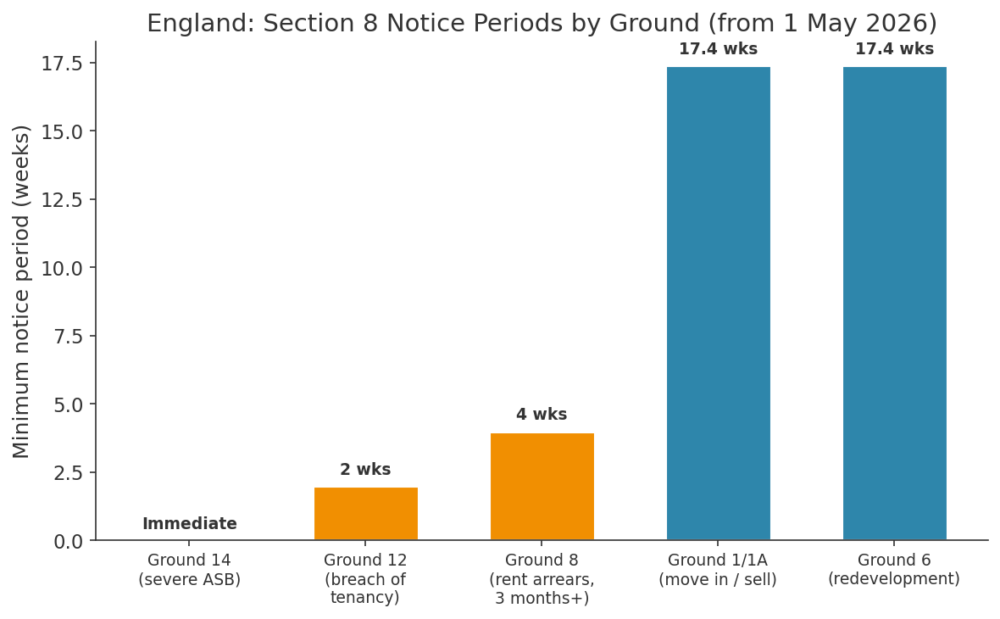
Figure 1: Minimum Section 8 notice periods by ground, England, from 1 May 2026. Source: GOV.UK.
Grounds 1, 1A and 6 also carry a twelve month protected period: a landlord cannot serve notice under these grounds until the tenancy has run for at least twelve months.
“This is usually 4 months but it can be shorter for some grounds.” — Ministry of Housing, Communities and Local Government, on Section 8 notice periods
Wales: The Section 173 Notice and Occupation Contracts
Wales moved away from assured shorthold tenancies under the Renting Homes (Wales) Act 2016. A tenancy is now a standard occupation contract, and a tenant is a contract holder, since 1 December 2022.
A landlord in Wales can still recover possession on a no-fault basis, but the mechanism looks nothing like Section 21. It is known as a section 173 notice, and it is considerably slower.
| Key Stat: A no-fault section 173 notice in Wales requires six months, three times longer than the old two-month Section 21 notice in England ever did. | ||
| England (from 1 May 2026) | Wales | |
| Governing law | Housing Act 1988, as amended | Renting Homes (Wales) Act 2016 |
| No-fault route | Abolished | Section 173 notice, 6 months |
| Rent arrears (serious) | Ground 8, 4 weeks | 1 month, or 14 days for 2+ months owed |
| Antisocial behaviour | Immediate, court acts after 14 days | Immediate possession order possible |
| Landlord registration | Not required nationally | Rent Smart Wales registration is mandatory |
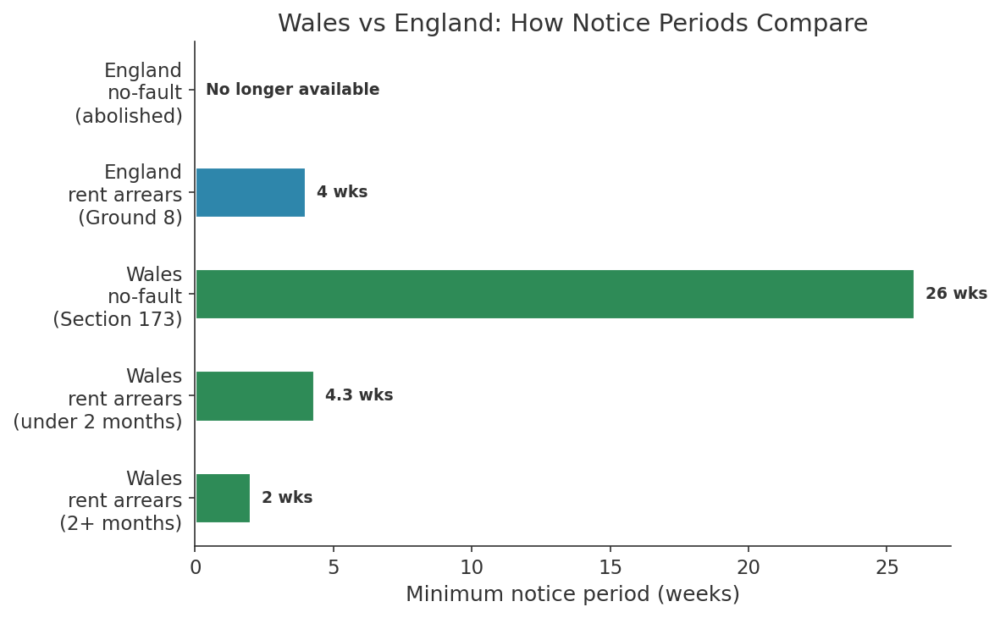
Figure 2: How minimum notice periods compare between Wales and England for common grounds.
The Six-Month Rule and Its Exceptions
A section 173 notice generally cannot be served until the first six months of a periodic contract have passed, and must give a further six months’ notice from that point. For a fixed term of two years or more, a landlord can use a break clause from the eighteenth month, again with six months’ notice.
Rent arrears move faster: notice after one month of missed payments, or fourteen days once two months’ rent is owed. Antisocial behaviour allows an immediate possession application.
Every landlord letting in Wales also needs Rent Smart Wales registration, a protected deposit, and current compliance certificates.
What Landlords Must Get Right Before Serving Any Notice
Whichever nation the property sits in, the paperwork behind the notice matters as much as the notice itself. Courts on both sides of the border expect to see it.
- A valid Electrical Installation Condition Report and, where applicable, a current gas safety certificate
- A valid Energy Performance Certificate
- The deposit protected in a government-approved scheme, with the required information given
- Working smoke alarms on every storey, and a carbon monoxide alarm where solid fuel is used
- A written statement of the tenancy or occupation contract terms, issued on time
Landlords who also hold retail property should not assume residential rules apply automatically. Anyone investing in a retail property will find the compliance checklist looks quite different once a business tenant is involved.
One renter reviewing Williams & Goodwin’s lettings service captured why this groundwork matters: “Kept us informed always with a professional and friendly attitude,” they wrote, adding that the team stayed responsive throughout the search.
This video walks through the ten headline changes the Act made to English tenancy law, including the new Section 8 grounds.
Common Mistakes That Invalidate a Notice
A landlord eviction notice that looks correct on the surface can still fail in court for reasons unrelated to the underlying dispute.
| Warning: Serving notice on the wrong form, using outdated wording, or getting the expiry date wrong is one of the most common reasons a possession claim is struck out at the first hearing. |
- Using an old Section 21 form or template after 30 April 2026
- Citing a ground that does not yet apply because the protected period has not elapsed
- Miscounting the notice period, particularly the date the notice is treated as served
- Applying to court more than twelve months after service, letting the notice expire
- A deposit protection failure, which blocks most grounds outright
Many of these errors mirror the legal mistakes retailers make when signing a commercial property agreement, where assuming a standard template covers every situation causes just as much trouble commercially.
A rented commercial unit works under a different framework again; retail landlords weighing up a commercial lease renewal or exit will find the rules sit closer to contract law than residential housing law.
Frequently Asked Questions
Can a landlord still evict a tenant in England without giving a reason?
No. Since 1 May 2026, every eviction in England must rely on a ground under Section 8 of the Housing Act 1988. No-fault Section 21 notices can no longer be served.
How long does a landlord eviction notice take in Wales?
It depends on the reason. A no-fault section 173 notice needs six months. Rent arrears cases move much faster, sometimes as little as fourteen days if two months or more is owed.
What happens if a tenant does not leave after the notice expires?
The landlord must apply to the county court for a possession order. Only bailiffs acting under a court warrant can lawfully remove a tenant.
Can a section 21 notice served before 1 May 2026 still be used?
Only if it was valid when served and the landlord applied to court by 31 July 2026. After that date, any unused notice has expired.
Getting the Process Right the First Time
The gap between England and Wales is now wide enough that a landlord operating across both nations needs two separate playbooks. England has traded a fast, no-fault route for a slower, evidence-based one; Wales has kept its own six-month, no-fault option while rent arrears routes stay quick.
What has not changed is the cost of getting it wrong. A notice built on the wrong template, timed incorrectly, or missing its supporting paperwork, tends to cost a landlord months rather than save them any.
References
Ministry of Housing, Communities and Local Government, Grounds for possession: guidance for tenants, 2026 — https://www.gov.uk/government/publications/grounds-for-possession-tenant-guidance/grounds-for-possession-guidance-for-tenants
Ministry of Housing, Communities and Local Government, Notices of possession served from 1 May 2026, 2026 — https://www.gov.uk/guidance/notices-of-possession-served-from-1-may-2026-a-guide-for-tenants-who-are-renting-from-a-private-landlord
Rent Smart Wales, Landlord Registration — https://rentsmart.gov.wales/en/landlord/landlord-registration/
Williams & Goodwin The Property People, Landlord notice to end a tenancy in Wales — https://tppuk.com/lettings/landlord-notice-to-end-tenancy-wales/
Citizens Advice, If you want to end your occupation contract (Wales) — https://www.citizensadvice.org.uk/wales/housing/ending-an-occupation-contract/ending-your-occupation-contract-w/
Fact Check: All statistics and data points in this article were verified against original sources, including GOV.UK guidance published and updated through August 2026, as of the article’s publication date. Sources are listed in the References section above.

Terry Clark is the Publisher and Content Director of 365 Retail, with more than a decade of experience covering retail design, technology innovations, store openings and the wider retail industry. He also works closely with leading retailers, suppliers, agencies, events and industry awards across the UK.