








In an age where almost anything can be ordered to your door, the act of visiting a physical store has become a conscious choice. Increasingly, it’s not purely to buy – it’s to browse, linger, and experience. That shift has profound implications for how retail spaces are designed.
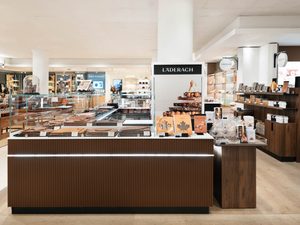
Shop-in-shop partnerships, once a practical solution to rent-sharing and range expansion, are evolving into something more strategic. They’re becoming tools of spatial storytelling: activating underutilised areas, extending dwell time, and reprogramming the rhythm of a shopping journey.


In this new context, the best partnerships are not just co-located, they’re co-curated.
From Convenience to Curiosity
Today’s shoppers no longer default to bricks-and-mortar. Online is faster, more efficient, and nearly infinite in choice. So when people do show up, they expect more than just a transaction, they expect to be surprised. That’s where design matters. A successful shop-in-shop experience doesn’t interrupt the retail journey, it enhances it. It creates moments of pause or excitement that feels organic, not forced.
Topshop’s pending arrival in John Lewis stores highlights the potential power of bringing a beloved brand universe into its space. With its own strong identity, loyal following, and cultural relevance, Topshop is set to broaden the store’s appeal and drive increased footfall. If strategically integrated alongside complementary brands and experiences, the halo effect could be game-changing for John Lewis, enhancing consumer perception across the wider store. This move has the potential to transform the space into a more expressive destination, encouraging longer dwell time and deeper customer engagement.
Beyond Product: Creating Brand Worlds
It’s not just about choice, it’s about context. Successful multi brand stores are about cohesion. Well-considered partnerships help customers feel like they’re moving through connected worlds, not discrete departments.
When store-in-store concepts work, it’s because they:
- Share values – A fashion retailer hosting a wellness brand works when both reflect a common ethos, like lifestyle, sustainability, or self-expression.
- Serve complementary audiences – Smart pairings attract new visitors without competing for the same spend. The goal is extension, not cannibalisation.
- Feel integrated by design – The strongest executions are spatially and sensorially seamless. They don’t look bolted on – they feel inevitable.
- This is where many partnerships falter: when they’re treated as transactional rather than intentional. Poorly executed concepts, badly lit, disconnected, or out of sync with the host brand, break the rhythm of the store and jar the customer experience.
Repositioning Through Placement
More than extending the experience or increasing sales, some partnerships actively reshape how we see brands.
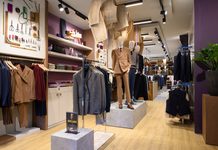
Levis’ space in Selfridges is a good example of how shop-in-shop partnerships can become powerful tools for brand positioning when approached as design interventions rather than simple space-sharing. The challenge wasn’t about blending in, but in adding something new to the Selfridges experience.
The space has been designed with longevity in mind, built to stay, evolve and grow with the brand. It gives Levi’s a more premium and lasting feel while keeping its sense of craft and authenticity, which is why the partnership works. It’s about adding value to the customer journey through design and storytelling and a reminder that the strongest collaborations help a brand evolve without losing its roots.
Designing for Time, Not Just Transactions
The most powerful shift happening in retail right now is temporal, not technological. It’s the idea that success lies not in how quickly a customer moves through a space, but in how long they choose to stay.
Shop-in-shop formats offer a way to stretch and sculpt that time. They break up the linearity of the retail journey. They create moments of contrast, conversation, and discovery. When designed well, they make stores feel less like distribution points and more like cultural venues.
Towards a New Model of Retail Design
For designers, strategists and brand architects, the implication is clear: partnerships are no longer just commercial agreements. They’re design interventions. They change how people navigate space, how they interpret brands, and what they take away from the experience. The question for brands is no longer “can we fit here?” It’s “Can we add something meaningful to this space?”
If the answer is yes, the opportunity is vast. Partnerships can turn underutilised spaces and whole floors of stores into destinations. They can attract new audiences without a full-scale rebrand. And they can help reimagine the role of retail in an increasingly digital world.
Shop-in-shop is not a new concept. But the way it’s being used is. Today, the smartest brands see it not as a logistical fix, but a creative strategy, one that lets them test ideas, reach new markets, and deliver experiences that feel worth showing up for.
The high street doesn’t need saving. It needs rethinking. And shop-in-shop partnerships, done with clarity, creativity and confidence, might just be one of the most powerful tools we have.

By Felicity Pogson, Director of Retail at Seen Studios
Related Posts